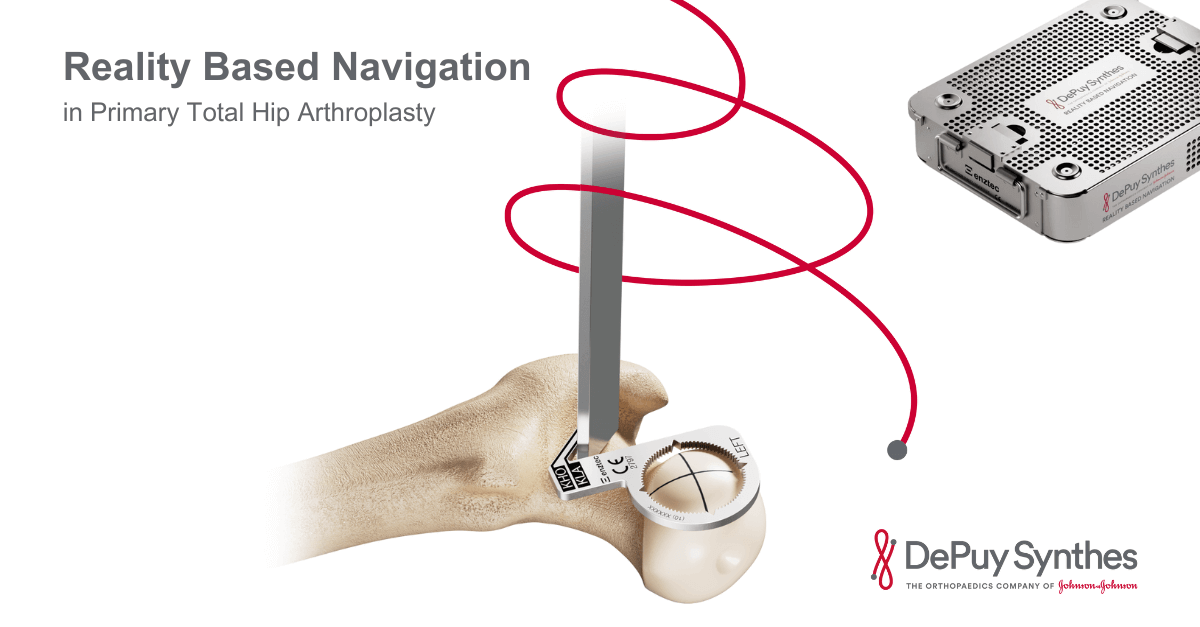
Restoring Hip Biomechanics by Reducing Intraoperative Variability
At the 24th EFORT Congress this week in Vienna, DePuy Synthes* is proud to showcase a recent addition to its hip portfolio in the Europe, Middle East and Africa region – Reality Based Navigation (RBN). The concept, developed by Professor David Beverland MD,* FRCS Consultant Orthopaedic Surgeon, took root over the past three decades in Belfast, Northern Ireland, beginning with a fellowship with Mike Wroblewski in 1988 that grew into a collective effort supported by over forty fellows.
Professor Beverland’s passion and ongoing research dedicated to improving THA outcomes have been embodied in a collection of evidence spanning over 70 publications since 1992. Like all visionary thought leaders in the field of orthopaedics, Professor Beverland has always believed that THA outcomes can be continuously improved. Subsequently, his work has been focused on reducing complications, increasing accuracy, and improving outcomes following primary THA, hence the introduction of RBN. According to Professor Beverland, “Reality Based Navigation (RBN) is designed to reduce unwanted implant malpositioning which can compromise both patient satisfaction and outcome.”
Designed to help surgeons achieve more consistent and reproducible results
The vision behind RBN is to enable surgeons to achieve more reproducible results with a simple, inexpensive technique, ensuring that every patient can gain access to the same high-level standard of care. RBN was developed to reduce the number of outliers with respect to component positioning,1 which may potentially increase accuracy during THA. Since one of the major objectives underlying the concept of RBN includes a focus on reducing or eradicating outliers, the introduction of RBN is therefore intended to help surgeons reduce any such outliers in their practices.
The need for a simple and affordable navigation technique
The sheer number of total hip arthroplasties, on the rise globally, presents a particular concern in countries like Germany, where the number of hip replacements is supposed to grow by a staggering 62% through 2059.2 Layer on a general rise in costs for orthopaedic procedures brought on by recent MedTech innovation, and the need arises for a simple and cost-effective solution to help improve accuracy in implant positioning during total hip replacement surgery.
Andrew Dalton***, Vice President of Joint Reconstruction, DePuy Synthes EMEA, elucidates the role of RBN in closing the gap between the continued need for precise surgical procedures and rising surgical costs in many markets. Reflecting upon the specific and unique role that Reality Based Navigation plays within the overall hip portfolio, he states:
“Our design innovation approach to hip implant technologies and procedures continues to lay the foundation for continuous improvement in THA, with intraoperative technologies playing an increasingly important role in hip replacement.
Based on hip expert Professor Beverland’s long-term research and experience, our RBN technique is designed to offer a simple solution aimed at improving technique-based consistency and procedural reproducibility while promoting the restoration of hip biomechanics.
A secondary aim of RBN is to meet the needs of markets in which economic access and significant cost pressure may present barriers to adoption of potentially less attainable digital technologies.”
How does RBN work?
The RBN technique aims to restore acetabular centre and femoral head centre independently, to achieve the restoration of the native global height and global offset of the joint. Surgeons utilize many methods to measure or estimate height and offset including navigation, templating, intraoperative x-ray or simple intraoperative navigation.3 Sometimes surgeons may use more than one of these methods to support accurate anatomical reconstruction.
Some of the key needs that the RBN system addresses include those associated with pre-operative planning, initial patient positioning, pre-operative patient marking, acetabular cup positioning, and intra-operative patient positioning. At its core, RBN is focused on four main objectives:
-
Restoration of femoral head centre (FHC)
-
Restoration of acetabular centre
-
Control of cup version
-
Control of cup radiographic inclination (RI)
During total hip arthroplasty (THA), native global offset must be restored in order to achieve proper functioning of the abductor muscles and to ensure that the hip joint is stable.4 These surgical objectives may be achieved primarily through determination of the location of the pelvic sagittal plane pre-operatively and intra-operatively, and the use of intra-operative landmarks to guide intraoperative navigation during the surgical workflow.
RBN plays a key role in our ongoing legacy of success serving hip surgeons
DePuy Synthes is revolutionizing hip reconstruction by delivering class-leading implants, strengthening technique offerings, and leading the MedTech transformation. RBN represents a clear win on the technique front, as well as a solution fully optimized for surgeons who desire innovation and results at a better cost point than can be obtained by some alternative THA navigation techniques.
The Reality Based Navigation technique introduces instruments that are compatible with the instruments, trials and implants of the standard CORAIL™ Hip System and PINNACLE™ Hip Solutions. This technique is intended for use in THA conducted using the posterior approach with the patient in the lateral decubitus position. Learn more about CORAIL and PINNACLE here.
For more information about DePuy Synthes Hip Solutions, visit the EMEA Hip Specialties page.
About Johnson & Johnson Medical Devices Companies
At Johnson & Johnson MedTech, we unleash diverse healthcare expertise, purposeful technology, and a passion for people to transform the future of medical intervention and empower everyone to live their best life possible. For more than a century, we have driven breakthrough scientific innovation to address unmet needs and reimagine health. In surgery, orthopaedics, vision, and interventional solutions, we continue to help save lives and create a future where healthcare solutions are smarter, less invasive, and more personalized.
About DePuy Synthes
DePuy Synthes, The Orthopaedics Company of Johnson & Johnson, provides one of the most comprehensive orthopaedics portfolios in the world that helps heal and restore movement for the millions of patients we serve. DePuy Synthes solutions, in specialties including joint reconstruction, trauma, extremities, craniomaxillofacial, spinal surgery and sports medicine, in addition to the VELYS™ Digital Surgery portfolio, are designed to advance patient care while delivering clinical and economic value to healthcare systems worldwide. Building on our proud product innovation and legacy of industry firsts, we are reimagining the orthopaedic landscape with new advancements in medical technologies and digital surgery across the entire continuum of care to Keep People Moving today and tomorrow. For more information, visit www.depuysynthes.com.
* DePuy Synthes represents the products and services of DePuy Synthes Sales, Inc., and its affiliates.
** Professor David Beverland is a design surgeon and a paid consultant of an affiliate of DePuy Synthes.
*** Andrew Dalton is an employee of Medical Device Business Services, Inc.
248715-230521 EMEA
© DePuy Synthes 2023. All rights reserved.
Please refer to the instructions for use for a complete list of indications, contraindications, warnings and precautions. This publication is not intended for distribution outside of the EMEA region. Third party trademarks used herein are the trademarks of their respective owners.
References:
- Rathod, P., Bhalla, S., Deshmukh, A. and Rodriguez, J., 2014. Does Fluoroscopy With Anterior Hip Arthoplasty Decrease Acetabular Cup Variability Compared With a Nonguided Posterior Approach?. Clinical Orthopaedics & Related Research, 472(6), pp.1877-1885.
- Klug, A., Pfluger, D.H., Gramlich, Y. et al. Future burden of primary and revision hip arthroplasty in Germany: a socio-economic challenge. Arch Orthop Trauma Surg 141, 2001–2010 (2021). https://doi.org/10.1007/s00402-021-03884-2
- Diamond OJ, Hill JC, McCann AJ, McGrath C, Napier RJ, Beverland DE. Using a ring to locate femoral head center in total hip arthroplasty. Hip Int. 2022 Sep;32(5):627-633. doi: 10.1177/11207000211005442.
- Bonnin, M., Archbold, P., Basiglini, L., Fessy, M. and Beverland, D., 2012. Do We Medialise the Hip Centre of Rotation in Total Hip Arthroplasty? Influence of Acetabular Offset and Surgical Technique. HIP International, 22(4), pp.371-378